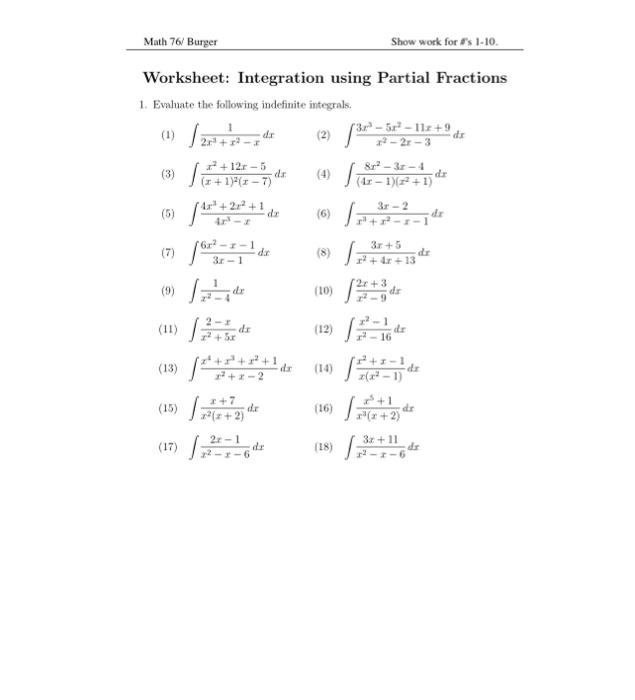
Breaking down complex mathematical expressions can feel like deciphering an ancient scroll. You know the treasure is there – the simpler, more manageable form – but getting to it requires the right tools and a clear map. This is precisely where Understanding Partial Fractions: A Comprehensive Guide becomes your indispensable resource. If you've ever stared down a daunting rational function, knowing there must be an easier way to integrate it or work with it, you've arrived at the solution.
Partial fraction decomposition isn't just a mathematical trick; it's a powerful strategy for transforming seemingly intractable problems into a series of simpler, solvable pieces. It's the secret weapon of calculus students, engineers, and anyone who needs to manipulate rational functions with precision and ease.
At a Glance: Your Quick Guide to Partial Fractions
- What it is: A method to break down complex algebraic fractions (rational functions) into a sum of simpler fractions.
- Why it matters: Makes integrating rational functions much easier, simplifies expressions for inverse Laplace transforms, and is fundamental in advanced mathematics and engineering.
- The core idea: Just as you can combine 1/2 + 1/3 into 5/6, partial fractions allow you to reverse the process, taking 5/6 and expressing it as 1/2 + 1/3.
- Key Requirement: The degree of the numerator must be less than the degree of the denominator (a "proper fraction"). If not, polynomial long division is your first step.
- Your tools: Factoring the denominator, setting up the correct form, and solving for unknown coefficients using strategic substitution or equating like terms.
The "Why" Behind the "What": Unpacking Rational Functions
Before we dive into decomposition, let's briefly clarify what we're working with. A rational function is simply the ratio of two polynomials, which we often write as P(x)/Q(x). Think of it like any ordinary fraction, but instead of numbers, you have algebraic expressions in the numerator (P(x)) and the denominator (Q(x)).
Now, not all rational functions are created equal when it comes to partial fractions. We have two critical classifications:
- Proper Fractions: This is where the magic of partial fractions truly begins. A rational function is a proper fraction when the degree (the highest exponent) of the numerator polynomial P(x) is less than the degree of the denominator polynomial Q(x).
- Example: (x + 1) / (x² + 1) — Here, degree of P(x) is 1, degree of Q(x) is 2. (1 < 2)
- Improper Fractions: These functions need a little pre-processing. A rational function is an improper fraction when the degree of P(x) is greater than or equal to the degree of Q(x).
- Example: (x² + 1) / x — Here, degree of P(x) is 2, degree of Q(x) is 1. (2 ≥ 1)
This distinction isn't just academic; it's the first critical checkpoint in partial fraction decomposition. Improper fractions must be converted into a sum of a polynomial and a proper fraction using polynomial long division before you can proceed with partial fraction decomposition on the remaining proper fraction. If you need to understand polynomial long division more deeply, it's a foundational skill for this initial step.
The Core Idea: What Exactly Are Partial Fractions?
Imagine you have a single, complex machine that's hard to understand or fix. Wouldn't it be easier if you could break it down into its individual, simpler components, work on each one, and then reassemble them? That's the essence of partial fraction decomposition.
The method allows us to take a single, proper rational function – especially one with a complicated denominator – and express it as a sum of two or more simpler rational functions. Each of these "simpler fractions" has a denominator that's typically just a linear or irreducible quadratic factor, making them far easier to handle.
Why go through all this effort?
The primary motivation, especially in calculus, is integration. Integrating a complex rational function directly can be a nightmare. However, once you decompose it into a sum of partial fractions, each individual partial fraction can usually be integrated using basic rules, often leading to simple logarithmic or inverse trigonometric functions. This transformation turns challenging integrals into a sum of basic integral forms, vastly simplifying the process. Beyond calculus, partial fractions are a prerequisite for advanced techniques in differential equations, Laplace transforms, and control systems, where manipulating rational functions is a daily task.
Your Step-by-Step Roadmap to Decomposition Success
Decomposing a rational function into partial fractions follows a clear, systematic path. Stick to these steps, and you'll find the process surprisingly straightforward.
Step 1: Check for Proper Fractions First (and Fix If Needed)
This is your non-negotiable starting point. If your rational function P(x)/Q(x) is improper (degree P(x) ≥ degree Q(x)), you absolutely must perform polynomial long division first. The result will be a polynomial plus a proper rational function. You'll then apply partial fraction decomposition only to this new proper rational function.
- Example: For (x² + 3x + 1) / (x + 1):
- Divide (x² + 3x + 1) by (x + 1).
- You'll get (x + 2) + (-1 / (x + 1)).
- Now, you only decompose -1 / (x + 1) (which is already a simple partial fraction).
Step 2: Factor That Denominator Like a Pro
The next crucial step is to completely factor the denominator, Q(x), into its simplest irreducible components. These components will dictate the form of your partial fractions. You'll encounter two main types of factors:
- Linear Factors: These are of the form (ax + b).
- Irreducible Quadratic Factors: These are of the form (ax² + bx + c), where the quadratic cannot be factored further into linear factors with real coefficients (i.e., its discriminant b² - 4ac is negative).
- Example: For (2x + 3) / (x² - 1), you'd factor the denominator as (x - 1)(x + 1).
- Example: For (x² + 4x + 1) / (x³ + 2x² + x + 2), you'd factor it as (x² + 1)(x + 2). Notice (x² + 1) is an irreducible quadratic.
Step 3: Setting Up the Right Form: The Decomposition Blueprint
This step is critical because the correct setup depends entirely on the factors of your denominator. Don't skip this, as an incorrect setup will lead you down the wrong path.
- Case 1: Distinct Linear Factors
- If Q(x) has distinct linear factors like (x - r₁)(x - r₂)...(x - rₙ), then for each factor (x - rᵢ), you'll have a term of the form A / (x - rᵢ).
- Example: For P(x) / ((x - 1)(x + 2)), the setup is A / (x - 1) + B / (x + 2).
- Case 2: Repeated Linear Factors
- If Q(x) has a linear factor (x - r) repeated 'n' times (i.e., (x - r)ⁿ), then for this factor, you'll need 'n' terms:
A₁ / (x - r) + A₂ / (x - r)² + ... + Aₙ / (x - r)ⁿ. - Example: For P(x) / ((x - 1)²(x + 2)), the setup is A / (x - 1) + B / (x - 1)² + C / (x + 2).
- Case 3: Irreducible Quadratic Factors
- If Q(x) has an irreducible quadratic factor (ax² + bx + c), then for this factor, you'll have a term of the form (Ax + B) / (ax² + bx + c).
- Example: For P(x) / ((x² + 1)(x - 2)), the setup is (Ax + B) / (x² + 1) + C / (x - 2).
- Case 4: Repeated Irreducible Quadratic Factors
- If Q(x) has an irreducible quadratic factor (ax² + bx + c) repeated 'n' times (i.e., (ax² + bx + c)ⁿ), then you'll need 'n' terms:
(A₁x + B₁) / (ax² + bx + c) + (A₂x + B₂) / (ax² + bx + c)² + ... + (Aₙx + Bₙ) / (ax² + bx + c)ⁿ. - This case is less common in introductory courses but follows the pattern.
Step 4: Clear the Denominators: Your Algebraic Shortcut
Once you've set up the partial fraction form, the next step is to eliminate all the denominators. Multiply both sides of your equation by the original common denominator Q(x). This will leave you with an equation involving only polynomials and your unknown coefficients (A, B, C, etc.).
- Example (from Case 1): If P(x) / ((x - 1)(x + 2)) = A / (x - 1) + B / (x + 2)
- Multiply both sides by (x - 1)(x + 2):
- P(x) = A(x + 2) + B(x - 1)
Step 5: Solving for Coefficients: Two Powerhouse Strategies
Now for the detective work: finding the values of A, B, C, and so on. You have two primary methods, and often, the most efficient approach is to combine them.
- Method A: Substituting "Convenient" Values (The Root Method)
- This is often the quickest way to find some coefficients, especially when you have distinct linear factors.
- Look at your factored denominator Q(x). Each linear factor (x - r) gives you a "root" r. Substitute these roots into the equation from Step 4. When you substitute x = r, the term associated with (x - r) will become zero, allowing you to isolate and solve for other coefficients.
- Example: If P(x) = A(x + 2) + B(x - 1)
- To find A, let x = 1: P(1) = A(1 + 2) + B(1 - 1) => P(1) = 3A => A = P(1) / 3.
- To find B, let x = -2: P(-2) = A(-2 + 2) + B(-2 - 1) => P(-2) = -3B => B = P(-2) / -3.
- This method is powerful for distinct linear factors but less effective for irreducible quadratics or finding all coefficients in complex repeated factor cases.
- Method B: Equating Coefficients (System of Equations)
- This method is more systematic and works for all types of factors.
- Expand the right side of the equation from Step 4.
- Group terms by powers of x (e.g., x², x, constant term).
- Equate the coefficients of corresponding powers of x on both sides of the equation. This will generate a system of linear equations.
- Example: If P(x) = x² + 3x + 1 and the setup is A(x + 2) + B(x - 1)
- x² + 3x + 1 = Ax + 2A + Bx - B
- x² + 3x + 1 = (A + B)x + (2A - B)
- Now equate coefficients:
- Coefficient of x²: 1 = 0 (Wait! This reveals a problem: if P(x) was indeed x² + 3x + 1, our initial function was improper, and we should have done long division first. This highlights the importance of Step 1!).
- Let's assume P(x) = 2x + 3.
- 2x + 3 = (A + B)x + (2A - B)
- Equate coefficients:
- x terms: A + B = 2
- Constant terms: 2A - B = 3
- Now you master solving systems of equations to find A and B. (Adding the two equations: 3A = 5 => A = 5/3. Substitute A back in: 5/3 + B = 2 => B = 2 - 5/3 = 1/3).
You can combine these methods: use Method A for values that make factors zero, and then use Method B to solve for any remaining coefficients.
Step 6: Write Your Final Expression
Once you've determined all the coefficients, substitute them back into your partial fraction setup from Step 3. This is your final decomposed expression.
- Example: If you found A = 5/3 and B = 1/3 for (2x + 3) / ((x - 1)(x + 2)), your final expression is (5/3) / (x - 1) + (1/3) / (x + 2).
Step 7: Verification (Optional but Recommended)
To ensure you haven't made any algebraic slips, you can quickly verify your result. Combine the partial fractions you found back into a single fraction. If your calculations are correct, this combined fraction should exactly match your original rational function. This step is particularly useful before moving on to integration, as a small error here can snowball.
Real-World Examples: Seeing Partial Fractions in Action
Let's walk through a couple of examples to solidify these steps.
Example 1: Distinct Linear Denominators
Decompose (2x + 3) / (x² - 1)
- Proper Fraction? Yes, degree of numerator (1) < degree of denominator (2).
- Factor Denominator: x² - 1 = (x - 1)(x + 1).
- Set Up Form: (2x + 3) / ((x - 1)(x + 1)) = A / (x - 1) + B / (x + 1)
- Eliminate Fractions: Multiply by (x - 1)(x + 1):
2x + 3 = A(x + 1) + B(x - 1) - Solve for Coefficients (using convenient values):
- Let x = 1: 2(1) + 3 = A(1 + 1) + B(1 - 1) => 5 = 2A => A = 5/2.
- Let x = -1: 2(-1) + 3 = A(-1 + 1) + B(-1 - 1) => 1 = -2B => B = -1/2.
- Write Final Expression:
(2x + 3) / (x² - 1) = (5/2) / (x - 1) - (1/2) / (x + 1)
Example 2: Irreducible Quadratic Denominator
Decompose (x² + x + 1) / (x(x² + 1))
- Proper Fraction? Yes, degree of numerator (2) < degree of denominator (3).
- Factor Denominator: Already factored: x(x² + 1). Note that (x² + 1) is irreducible as 1² - 4(1)(1) = -3 < 0.
- Set Up Form: (x² + x + 1) / (x(x² + 1)) = A / x + (Bx + C) / (x² + 1)
- Eliminate Fractions: Multiply by x(x² + 1):
x² + x + 1 = A(x² + 1) + (Bx + C)x - Solve for Coefficients:
- Use convenient value (for the linear factor): Let x = 0
0² + 0 + 1 = A(0² + 1) + (B(0) + C)(0)
1 = A(1) + 0 => A = 1. - Now use equating coefficients (since we have a quadratic term):
Substitute A = 1 into the equation:
x² + x + 1 = 1(x² + 1) + (Bx + C)x
x² + x + 1 = x² + 1 + Bx² + Cx
x² + x + 1 = (1 + B)x² + Cx + 1
Equate coefficients: - Coefficient of x²: 1 = 1 + B => B = 0.
- Coefficient of x: 1 = C => C = 1.
- Constant term: 1 = 1 (Checks out, consistent).
- Write Final Expression:
(x² + x + 1) / (x(x² + 1)) = 1 / x + (0x + 1) / (x² + 1) = 1 / x + 1 / (x² + 1)
Beyond Decomposition: Integrating with Partial Fractions
The true power of partial fraction decomposition shines in calculus, specifically in integration. Once you've broken down a complex rational function into simpler terms, integrate rational functions effectively using standard integration formulas.
Consider our first example: ∫ (2x + 3) / (x² - 1) dx
After decomposition, this becomes: ∫ [(5/2) / (x - 1) - (1/2) / (x + 1)] dx
Now, these are straightforward integrals:
- ∫ (5/2) / (x - 1) dx = (5/2) ln|x - 1| + C₁
- ∫ (-1/2) / (x + 1) dx = (-1/2) ln|x + 1| + C₂
Combining them, we get: (5/2) ln|x - 1| - (1/2) ln|x + 1| + C
Using logarithm properties (a ln b = ln b^a and ln a - ln b = ln(a/b)), we can simplify:
ln(|x - 1|^(5/2)) - ln(|x + 1|^(1/2)) + C = ln(|(x - 1)^(5/2) / (x + 1)^(1/2)|) + C
For terms involving irreducible quadratic denominators like 1 / (x² + 1) (from Example 2), you'll often encounter inverse trigonometric functions. The integral of 1 / (x² + a²) dx is (1/a) arctan(x/a) + C.
For more complex (Ax + B) / (ax² + bx + c) terms, you typically complete the square in the denominator and then use a combination of u-substitution and inverse trigonometric forms. Always remember to add the constant of integration, +C, for indefinite integrals.
Common Traps & Pro Tips for Partial Fraction Mastery
Even with a clear roadmap, certain pitfalls can trip you up. Here's how to navigate them like a pro:
- Sign Errors are Sneaky: When expanding expressions or distributing negative signs, it's incredibly easy to make a small error that throws off your entire solution. Double-check every multiplication and subtraction step.
- Algebraic Verification is Your Best Friend: Before you declare victory, take a moment to re-check your calculations. A quick way to spot an error is to substitute your found coefficients back into the partial fractions and then combine them to see if you get the original function.
- Don't Forget +C: Forgetting the constant of integration in indefinite integrals is a common oversight that can cost you points in a calculus context. Make it a habit!
- Leverage Logarithmic Properties: After integration, often you'll end up with a sum or difference of logarithmic terms. Simplifying these using properties like ln(a) + ln(b) = ln(ab) or a ln(b) = ln(b^a) can make your final answer much cleaner and more elegant.
- Choose the Right Solving Method: The "convenient values" method (substituting roots) is usually faster for distinct linear factors. For repeated factors or irreducible quadratics, or when you can't find enough unique roots, equating coefficients is more reliable. A hybrid approach often works best: use roots where possible, then equate coefficients for the remaining unknowns.
- Computer Algebra Systems (CAS) as a Check, Not a Crutch: Tools like Wolfram Alpha or Use our partial fraction generator can quickly decompose functions or perform integrations. Use them to verify your work and check your answers, but don't rely on them to learn the process. The understanding comes from doing it yourself.
Frequently Asked Questions (FAQs)
When do I have to use partial fractions?
You must use partial fractions when you need to integrate a proper rational function whose denominator can be factored into linear and/or irreducible quadratic factors, and direct integration (like u-substitution) isn't immediately obvious. It's also essential in other areas like finding inverse Laplace transforms.
Can I use partial fractions if the denominator doesn't factor?
If the denominator is an irreducible quadratic (e.g., x² + 1, x² + x + 1) or a product of such factors, yes, you can. You'll use the (Ax + B) / (ax² + bx + c) form. If the denominator is prime (like x^2+x+7 which cannot be factored into real linear factors), it’s already in its simplest form for that type of denominator, and partial fraction decomposition wouldn't break it down further, but you might still integrate it via other methods like completing the square and using arctan.
Is there an easier way?
For performing the decomposition itself, Computer Algebra Systems (CAS) are the "easier way" in terms of computation. However, for genuinely understanding the underlying math and for excelling in contexts like exams, there's no shortcut around mastering the manual process. The conceptual understanding gained from partial fractions also unlocks methods for more advanced topics.
What about other applications of partial fractions beyond integration?
Partial fractions are fundamental in:
- Laplace Transforms: When finding the inverse Laplace transform of a rational function, partial fraction decomposition is often the first step to break it into forms recognizable from Laplace transform tables.
- Solving Differential Equations: This technique is often used in conjunction with Laplace transforms to solve certain types of differential equations, particularly those modeling electrical circuits or mechanical systems.
- Control Systems Engineering: Analyzing transfer functions in control systems frequently involves partial fraction decomposition to understand system response.
Your Next Steps in Mathematical Mastery
You've now got a solid grasp of partial fractions, from the foundational concept of rational functions to the step-by-step process of decomposition and its crucial application in integration. This isn't just a collection of rules; it's a powerful framework that demystifies complex algebraic fractions and empowers you to tackle them with confidence.
The best way to solidify this knowledge is through practice. Work through various examples, especially those with repeated linear and irreducible quadratic factors. Try to predict the form of the partial fractions before you solve for the coefficients.
As you continue your mathematical journey, remember that partial fractions are just one of many powerful explore other integration techniques at your disposal. Each one is a tool, and knowing when and how to wield it effectively is the hallmark of a true mathematical artisan. Embrace the decomposition, and watch as your understanding of rational functions – and your ability to manipulate them – transforms.