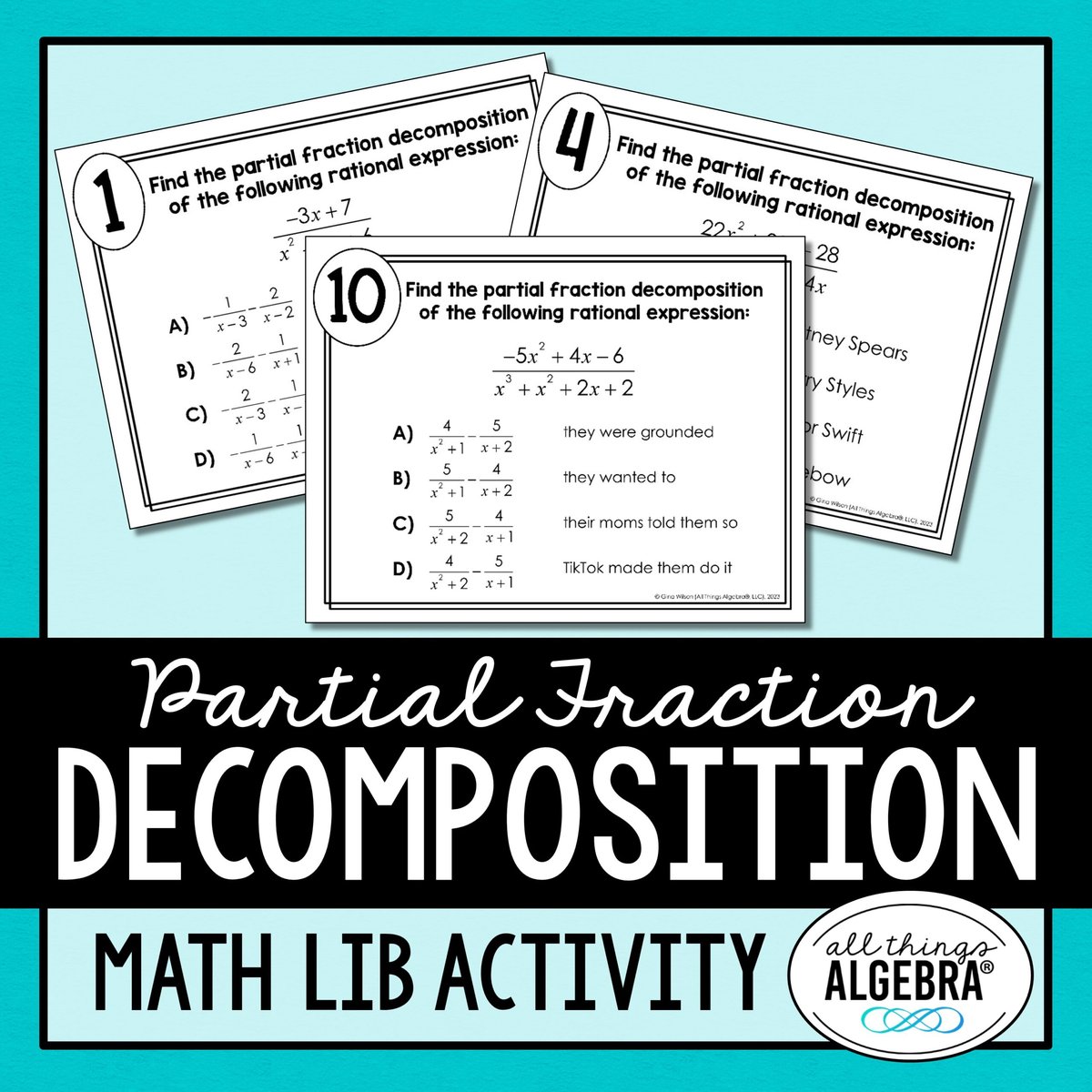
Ever stared down a monstrous rational expression, feeling like you're trying to untangle a knot with a pair of boxing gloves? What if I told you there's a surprisingly elegant, step-by-step manual partial fraction decomposition technique that can transform those intimidating fractions into a collection of simpler, more manageable pieces? This isn't just a math trick; it's a fundamental skill, particularly for anyone navigating the waters of integral calculus, offering a powerful way to reverse-engineer complex expressions.
Think of it like breaking down a gourmet dish into its individual ingredients: instead of trying to understand the whole complex flavor profile at once, you identify the distinct components that make it up. That's exactly what we're going to do here – simplify for clarity and, ultimately, for easier manipulation.
At a Glance: What You'll Master
- Deconstruct complex fractions: Learn to break down formidable rational expressions into simpler, additive parts.
- Identify factor types: Understand how different types of denominator factors (linear, quadratic, repeated) dictate your setup.
- Master solving techniques: Become proficient in both the substitution and coefficient comparison methods to find unknown values.
- Avoid common pitfalls: Get practical tips to sidestep errors and make the process smoother.
- Prepare for advanced calculus: See why this algebraic skill is indispensable for solving certain types of integrals.
Why Even Bother? The Power of Simplification
In the realm of mathematics, particularly calculus, you'll often encounter rational expressions like (2x + 1) / (x^2 - 1). Trying to integrate or manipulate such expressions directly can be a nightmare. Partial fraction decomposition is the algebraic equivalent of a "simplify" button. It breaks that single, complex fraction into a sum of simpler fractions, each of which is far easier to handle.
For instance, (2x + 1) / (x^2 - 1) can be decomposed into (3/2)/(x-1) + (1/2)/(x+1). Notice how much simpler those individual components are? Each one is now trivial to integrate, a task that was much harder for the original expression. This method is your secret weapon for transforming intractable problems into solvable ones.
The Golden Rule: Proper Rational Expressions Only
Before you even think about setting up partial fractions, there’s a critical checkpoint: Is your rational expression "proper"?
A proper rational expression is one where the degree (highest power) of the numerator polynomial is less than the degree of the denominator polynomial.
- Example of Proper:
(3x + 2) / (x^2 - 4)(Numerator degree 1, Denominator degree 2) - Example of Improper:
(x^3 + 2x) / (x^2 - 1)(Numerator degree 3, Denominator degree 2)
If you have an improper rational expression, you must perform polynomial long division first. This will result in a polynomial plus a proper rational expression. You then apply partial fraction decomposition only to that resulting proper rational expression. Don't skip this step – it's foundational!
Unpacking the Denominator: The Blueprint for Your Fractions
The heart of partial fraction decomposition lies in how you "decode" the denominator. Its factored form dictates the structure of your simpler fractions. Our first major step, then, is to completely factor the denominator into a product of linear and/or irreducible quadratic factors. Remember, "irreducible" means it can't be factored further into real linear factors.
Here's how different factor types dictate your partial fraction setup:
1. Distinct Linear Factors (e.g., ax + b)
When your denominator has unique linear factors, each one gets its own simple fraction with a constant in the numerator.
Form: For each factor (ax + b), you'll have a term A / (ax + b).
Example: If the denominator is x(x-2)(x+3), your setup would be:A/x + B/(x-2) + C/(x+3)
2. Repeated Linear Factors (e.g., (ax + b)^n)
If a linear factor is raised to a power n, you need to include n terms, with the factor's power increasing from 1 up to n. Each numerator will still be a constant.
Form: For a factor (ax + b)^n, you'll have A1/(ax+b) + A2/((ax+b)^2) + ... + An/((ax+b)^n).
Example: If the denominator is (x-1)^3, your setup would be:A/(x-1) + B/((x-1)^2) + C/((x-1)^3)
3. Distinct Irreducible Quadratic Factors (e.g., ax^2 + bx + c)
For each unique quadratic factor that cannot be factored further over real numbers (e.g., x^2 + 1, x^2 + x + 1), its corresponding numerator will be a linear expression. The degree of the numerator is always one less than the degree of its denominator.
Form: For each factor (ax^2 + bx + c), you'll have a term (Ax + B) / (ax^2 + bx + c).
Example: If the denominator is (x^2 + 4)(x-1), your setup would be:A/(x-1) + (Bx + C)/(x^2 + 4)
4. Repeated Irreducible Quadratic Factors (e.g., (ax^2 + bx + c)^n)
Similar to repeated linear factors, if an irreducible quadratic factor is raised to the power n, you'll need n terms. Each term will have a linear numerator, and the quadratic factor's power will increase with each successive term.
Form: For a factor (ax^2 + bx + c)^n, you'll have (A1x+B1)/(ax^2+bx+c) + (A2x+B2)/((ax^2+bx+c)^2) + ... + (Anx+Bn)/((ax^2+bx+c)^n).
Example: If the denominator is (x^2 + x + 1)^2, your setup would be:(Ax + B)/(x^2 + x + 1) + (Cx + D)/((x^2 + x + 1)^2)
The Step-by-Step Playbook: Solving for the Unknowns
Once you've correctly set up your partial fractions, the next challenge is to find the values of those unknown coefficients (A, B, C, etc.). This is where the real "manual" work comes in.
Step 1: Clear the Denominators
Your first move is to eliminate all denominators. Multiply both sides of your equation (the original expression set equal to your partial fraction setup) by the Least Common Denominator (LCD). The LCD will always be the original denominator of your rational expression.
This step will leave you with an equation involving polynomials on both sides, free from fractions.
Example: Suppose you start with (2x+1) / (x(x+1)) = A/x + B/(x+1).
Multiply both sides by x(x+1):2x+1 = A(x+1) + Bx
Step 2: Solve for Unknown Coefficients
This is the core problem-solving stage. You have two primary methods, and often, the most efficient approach combines both.
Method A: The Substitution Method (The "Shortcut" for Linear Factors)
This method is incredibly powerful and fast, especially when dealing with linear factors. It leverages the roots (or zeros) of your linear factors to isolate and solve for individual coefficients.
- Identify Roots: Find the values of
xthat make each linear factor in the original denominator equal to zero. - Substitute: Plug these
xvalues into the polynomial equation you obtained after clearing denominators. - Solve: Since substituting a root will cause some terms to vanish (because their linear factor becomes zero), you'll often be left with a simple equation that directly solves for one coefficient.
Continuing our example:2x+1 = A(x+1) + Bx
- To find A: Set
x = 0(the root of the factorx).2(0) + 1 = A(0+1) + B(0)1 = A(1) + 0A = 1 - To find B: Set
x = -1(the root of the factorx+1).2(-1) + 1 = A(-1+1) + B(-1)-2 + 1 = A(0) - B-1 = -BB = 1
So, in this case,A=1andB=1. Simple!
Method B: The Coefficient Comparison Method (The "Workhorse")
This method is more robust and works for all types of factors, including irreducible quadratics where substitution isn't as straightforward. It's also essential when the substitution method doesn't yield enough equations to solve for all unknowns.
- Expand and Collect: Expand all terms on the right side of your polynomial equation.
- Group by Powers of x: Collect terms that have the same power of
x(e.g.,x^2,x, constant terms). - Equate Coefficients: Compare the coefficients of corresponding powers of
xon both sides of the equation. This will create a system of linear equations. - Solve the System: Use techniques like substitution, elimination, or matrix methods to solve for your unknown coefficients. Remember to use zero placeholders for any missing powers of x on either side (e.g., if you have
2x+1on one side andAx^2 + Bx + Con the other, you'd treat2x+1as0x^2 + 2x + 1).
Let's use our example again for demonstration:2x+1 = A(x+1) + Bx - Expand:
2x+1 = Ax + A + Bx - Group by Powers of x:
xterms:2x = Ax + Bx=>2 = A + B- Constant terms:
1 = A
- Equate Coefficients & Solve:
From constant terms:A = 1
SubstituteA=1into thexterm equation:2 = 1 + B=>B = 1
Both methods yieldA=1andB=1. The substitution method was quicker here due to the simple linear factors.
Step 3: Substitute Values Back into the Partial Fraction Setup
Once you've found all your coefficients, the final step is to plug those values back into your original partial fraction setup.
Our example:
Original setup: (2x+1) / (x(x+1)) = A/x + B/(x+1)
With A=1 and B=1: (2x+1) / (x(x+1)) = 1/x + 1/(x+1)
And just like that, you've decomposed your expression!
Putting It All Together: Decomposition Scenarios with Examples
Let's walk through a few common scenarios to solidify your understanding.
Scenario 1: Denominator with Distinct Linear Factors
Problem: Decompose (3x + 7) / (x^2 + 5x + 6)
- Check Proper Rational Expression: Numerator degree 1, denominator degree 2. It's proper.
- Factor Denominator:
x^2 + 5x + 6 = (x+2)(x+3) - Set Up Partial Fractions: Distinct linear factors.
(3x + 7) / ((x+2)(x+3)) = A/(x+2) + B/(x+3) - Clear Denominators: Multiply by
(x+2)(x+3).3x + 7 = A(x+3) + B(x+2) - Solve for Coefficients (using Substitution):
- To find A: Set
x = -2(root ofx+2).3(-2) + 7 = A(-2+3) + B(-2+2)-6 + 7 = A(1) + B(0)1 = A - To find B: Set
x = -3(root ofx+3).3(-3) + 7 = A(-3+3) + B(-3+2)-9 + 7 = A(0) + B(-1)-2 = -BB = 2
- Substitute Values:
(3x + 7) / (x^2 + 5x + 6) = 1/(x+2) + 2/(x+3)
Scenario 2: Denominator with Repeated Linear Factors
Problem: Decompose (x^2 - x + 6) / ((x-1)(x-2)^2)
- Check Proper: Numerator degree 2, denominator degree 3. It's proper.
- Factor Denominator: Already factored:
(x-1)(x-2)^2 - Set Up Partial Fractions: Distinct linear factor
(x-1)and repeated linear factor(x-2)^2.(x^2 - x + 6) / ((x-1)(x-2)^2) = A/(x-1) + B/(x-2) + C/((x-2)^2) - Clear Denominators: Multiply by
(x-1)(x-2)^2.x^2 - x + 6 = A(x-2)^2 + B(x-1)(x-2) + C(x-1) - Solve for Coefficients (Combination of Substitution and Comparison):
- Using Substitution (for A and C):
- To find A: Set
x = 1(root ofx-1).1^2 - 1 + 6 = A(1-2)^2 + B(1-1)(1-2) + C(1-1)6 = A(-1)^2 + B(0) + C(0)6 = A(1)A = 6 - To find C: Set
x = 2(root ofx-2).2^2 - 2 + 6 = A(2-2)^2 + B(2-1)(2-2) + C(2-1)4 - 2 + 6 = A(0) + B(0) + C(1)8 = C - Now we have A=6 and C=8. To find B, let's use Coefficient Comparison or another substitution.
We havex^2 - x + 6 = A(x^2 - 4x + 4) + B(x^2 - 3x + 2) + C(x-1)x^2 - x + 6 = Ax^2 - 4Ax + 4A + Bx^2 - 3Bx + 2B + Cx - C
Groupx^2terms:1x^2 = Ax^2 + Bx^2=>1 = A + B
Since we knowA=6:1 = 6 + BB = -5
(You could also pick an easyxvalue, likex=0, and substituteAandCto findB:0^2 - 0 + 6 = A(0-2)^2 + B(0-1)(0-2) + C(0-1)6 = A(4) + B(2) + C(-1)6 = 6(4) + B(2) + 8(-1)6 = 24 + 2B - 86 = 16 + 2B-10 = 2BB = -5. Both methods work!)
- Substitute Values:
(x^2 - x + 6) / ((x-1)(x-2)^2) = 6/(x-1) - 5/(x-2) + 8/((x-2)^2)
Scenario 3: Denominator with Distinct Linear and Irreducible Quadratic Factors
Problem: Decompose (5x^2 + 3x + 1) / (x(x^2 + x + 1))
- Check Proper: Numerator degree 2, denominator degree 3. It's proper.
- Factor Denominator: Already factored:
x(x^2 + x + 1). Notex^2 + x + 1is irreducible because its discriminantb^2 - 4ac = 1^2 - 4(1)(1) = 1 - 4 = -3 < 0. - Set Up Partial Fractions: Distinct linear factor
xand distinct irreducible quadratic factorx^2 + x + 1.(5x^2 + 3x + 1) / (x(x^2 + x + 1)) = A/x + (Bx + C)/(x^2 + x + 1) - Clear Denominators: Multiply by
x(x^2 + x + 1).5x^2 + 3x + 1 = A(x^2 + x + 1) + (Bx + C)x - Solve for Coefficients (Combination of Substitution and Comparison):
- Using Substitution (for A):
- To find A: Set
x = 0(root ofx).5(0)^2 + 3(0) + 1 = A(0^2 + 0 + 1) + (B(0) + C)(0)1 = A(1) + 0A = 1 - Using Coefficient Comparison (to find B and C, now that A is known):
Expand the equation:5x^2 + 3x + 1 = Ax^2 + Ax + A + Bx^2 + Cx5x^2 + 3x + 1 = (A+B)x^2 + (A+C)x + A
Equate coefficients: x^2terms:5 = A + Bxterms:3 = A + C- Constant terms:
1 = A
From constant terms,A=1(confirms our substitution).
Fromx^2terms:5 = 1 + B=>B = 4
Fromxterms:3 = 1 + C=>C = 2
- Substitute Values:
(5x^2 + 3x + 1) / (x(x^2 + x + 1)) = 1/x + (4x + 2)/(x^2 + x + 1)
Common Pitfalls and Pro Tips
- Forgetting to check if the expression is proper: Always perform polynomial long division if the numerator's degree is equal to or greater than the denominator's. This is the most common beginner mistake.
- Incorrectly factoring the denominator: A single error here will derail your entire setup. Double-check your factoring, especially for irreducible quadratics.
- Mistakes in setting up partial fractions: Remember the rules: constant for linear,
Bx+Cfor irreducible quadratic. Increase powers for repeated factors. - Algebraic errors when clearing denominators: Be meticulous with your multiplication and distribution.
- Inefficient solving strategy: For linear factors, substitution is almost always faster. For quadratic factors or when substitution doesn't provide enough equations, coefficient comparison is your best friend. Often, a blend of both is ideal.
- Lost in the weeds? Take a break! Sometimes stepping away for a moment can help you spot a missed
xor a sign error. - Checking your work: A great way to check your final decomposition is to combine the simpler fractions back into a single one. Does it match the original expression? This will confirm your coefficients are correct.
Beyond the Manual: When to Leverage Tools
While mastering the step-by-step manual partial fraction decomposition is crucial for building a strong foundational understanding, there will be times when the expressions become incredibly complex or you need to verify your work quickly. This is where computational tools shine. Many online calculators and software packages can perform partial fraction decomposition instantly.
For those moments when you need a quick check or want to see the solution to a particularly gnarly expression, consider using Our partial fraction generator. It's a fantastic resource for confirming your manual solutions and learning from different problem types. Just input your rational expression, and it can show you the decomposed form.
Your Next Steps to Mastering Decomposition
Partial fraction decomposition might seem daunting at first, but like any skill, it improves with practice. The key is to be systematic:
- Always start with the "proper" check.
- Factor the denominator meticulously.
- Set up your partial fractions according to the factor types.
- Clear denominators carefully.
- Strategically solve for coefficients using a combination of substitution and comparison.
- Substitute your found values back in.
Don't shy away from working through many examples. The more you practice, the more intuitive the process will become. Soon, you'll be breaking down complex rational expressions with confidence, ready to tackle any integral or algebraic challenge that comes your way. Keep practicing, and you'll find these once-intimidating problems become surprisingly straightforward.